Hydrogen Update Q3 2026
Hello my Wonder Friends,
Toyota Cozies up to Volvo and Daimler Truck
When it comes to hydrogen, Toyota has always run a contrarian course. They continue investing in the technology as a strong alternative to electric for the future. Going it alone is expensive business though and the Japanese company tries to pull as many partners in its orbit as possible. Where BMW is the favorite in the car space, they are looking to join Cellcentric, the joint-venture of Volvo Group and Daimler Truck as an equal third partner. You might wonder why the trio is joining up, as both Toyota and the German-Swedish group have production ready fuel cells available. The answer is probably to be found in the roll-out of the ecosystem needed to support products on the road. Having the vehicles is useless without a tremendously expensive refueling and support network. They will need every ounce of cooperation they can muster to get that off the ground.
Your Construction Site or Festival Powered by Hydrogen
Ever wonder how big construction sites or festivals in the middle of endless fields get the juice to function? The answer lies in those workhorses toiling away tucked away in a corner: the good old generator. While they offer a relatively cheap way to get electricity on the go, these machines are a source of noise, exhaust fumes and a serious carbon footprint. At a festival or commercial event all three are unwanted, but also at construction sites the push for lower emissions is being felt. Either the local legislation mandates cleaner operations or the customer writes strict requirements into the building mandate.
JCB is now providing a hydrogen generator as the perfect solution for these challenges. Identical in size and manipulation as their diesel variants, these machines can provide power when batteries or solar are not up to the task, with much lower emissions than traditional alternatives. Lower emissions, but not zero. These generators run with an internal combustion engine adapted for hydrogen use. While much better than alternatives, there is still combustion and exhaust involved. The next jump in application will be to have a powerful enough fuel cell integrated into these containers, cutting all emissions and leaving only water vapor as a reminder of the power that was produced. While these generators do already exist, they are mostly of the stationary kind. Providing backup or peak support power to data centers for example. Real towable or containerized drop-off solutions of mainstream manufacturers are still in the works.
BMW X5 has Serious Case of FOMO
It seems you can't write an update on hydrogen without mentioning Toyota or BMW, and often both. As we have already had the Japanese, time for a peek at what they are up to in Southern Germany.
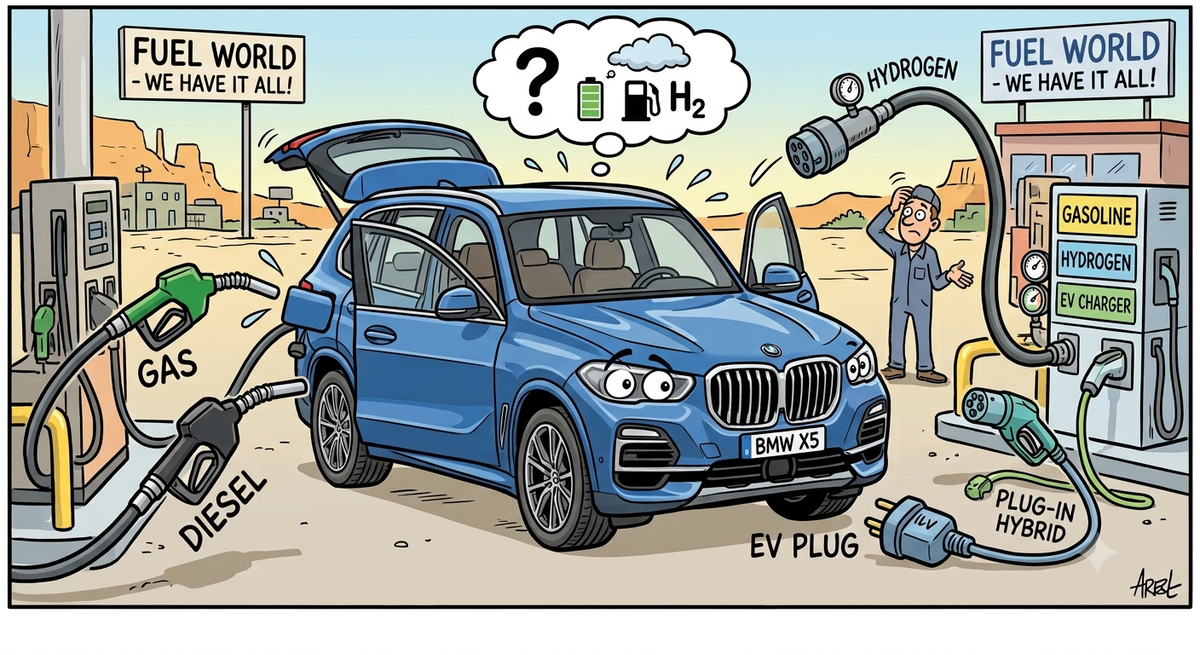
BMW has just presented its new X5. While there was massive attention, and some social media frenzy, for the "fat" fully electric version with its massive battery, there will also be a hydrogen sibling in the lineup. Yes, the X5 will not be riding on the new platform that is in use for the iX3, but an older one that can accommodate combustion engines and other solutions more easily. It is thus refusing to choose exclusively for one fuel type. You can expect a wide array of choice from traditional combustion and electric to the exotic and competition-less hydrogen variant. Depending on the importer near you or course.
The hydrogen fuel cell version of the X5 will not have a battery in its belly, but 7 carbon-fibre tanks that are all interconnected. They can store their fuel at 700 bar, allowing for over 700 km of range on one filling. If you can find the right hydrogen station, probably mixed in between some trucks, you can fill your car up in 5 minutes or less. In the past this range and refueling rate would be a real USP against fully electric cars, but with the speed of innovation in battery technology that is no longer the case. As I wrote in a recent battery update, CATL and BYD have already presented their newest goodies that can hit 10-90% in under 5 minutes. While finding charging stations that can deliver that kind of power will be just as difficult as spotting a hydrogen refueling one, at least they can settle for something slower at thousands of other spots.
Grtz
Pieter
PS: If you think this newsletter could interest someone you know, please forward this email. They can sign up for free on this link.