Charging Update Q2 2026
Hello dear Wonderers,
Clear Indication of Maturity: the Points People Have Arrived
There could not be a better indicator of just how mature charging has become in our daily lives as the proliferation of points savings schemes that are popping up. Some stores still use stickers or stamps, while others spend millions on apps and incredibly elaborate earning systems (here's looking at you dear airlines). Those who were hoping that charging would be different will be disappointed. Both Delhaize and Total Energies have announced that you can earn loyalty credits that can be turned into gift vouchers to spend in affiliated stores. In France E.Leclerc has also jumped on the wagon.
That this practice gains traction in Belgium is no surprise. As the electrification of the fleet is going fastest for company cars whose drivers are immune for pricing signals, companies have to make sure they keep coming back by using other incentives.
Another interesting development of these systems is how they give insight into the business model of charging providers. They don't just try to keep you coming back to their sites, but also use the leverage of the credits to steer you in other ways. Towards charging stations that have a lower occupation rate for example. Or bonus points for those who move their vehicle after the charging is over, so someone else can start collecting. While I fully agree that getting rewarded for helping them make money, I can never shake the feeling of unease when it's not entirely clear who is working for whom😉.
Big Fleets, Big Discounts
Another big indication that charging is turning into a very normal, dare I say boring, business are the big deals that are beginning to see the light. Allego and Uber have announced an agreement that will let drivers charge with a serious discount at all chargers throughout the Netherlands. From a pricing perspective the deal is quite simple, Allego lops 50% of the price per kwh. It's in the finer details that it gets interesting. The discount is only available during certain times. At the the time of the announcement that was set from 17:00 to 10:00. While both companies mention that they want to take net congestion and other parameters into account, it does seem to me that the expectation is clearly that Uber drivers will massively go for the HPC chargers and Allego wants those to be free in the middle of the day. Net congestion and occupation rates at the slower AC chargers be damned.
Flash > Super
Forget supercharging, flash charging is the new king in town. Ever since Tesla opened their first Superchargers the evolution of what is considered seriously fast charging has been gradual. I remember gazing at the screen of a Tesla Model S sucking up 110 kw of power back in 2014. The first time I tested an Hyundai EV6 a few years ago, I was just as amazed when it hit 230 kw at a Fastned station. And now, driving a Smart #5, I plan my routes around chargers that can deliver at least 350 kw and was happy as a baby when I noticed it going above 400 kw for the first time.
Forget slow and steady steps though. As mentioned in an earlier article BYD has fired the first salvo in the Megawatt charging race and there is a torrent of new developments coming that will leave the current technology looking pretty pedestrian. Geely has already shown off a Lync & Co 10+ that can handle similar levels of power and CATL, the 300 pound gorilla in the world of batteries, is rolling out the 3rd generation of its Shenxing battery. It outdoes BYD's with a 10 to 98% charge in only 6 minutes 27 second. 10 to 80% drops below 4 minutes! That is faster than the original battery swaps from Nio and pretty close to what it takes you to refuel a combustion car. Hell, if you have to go inside the petrol station to pay, you will actually be stopping for longer.
Forget range and charging anxiety, the technology that brings parity with ICE vehicles has now truly arrived. The only potential roadblock standing between you and a flawless electric road trip will be the density of traffic you are traveling with. Avoid the travel peaks and it will be boringly ordinary.
Charging Ain't Cheap? Do your Homework!
Charging, especially the fast charging HPC kind is far from cheap. But there are plenty of ways you can lighten the load. We have talked about the options of taking a subscription in previous quarterly updates but there are other things you can focus on.
Stay in the walled garden of your provider for example. Charging providers were never big fans of the European AFIR regulation that forced them to provide general purpose paying options at their charging stations. They also don't like giving a cut of their revenue to other mobility integrators with their big network cards. Just how much it is worth to them to keep you close is showing up in their pricing options. Fastned for example is joining Ionity, Electra and others with a hefty discount for users who pay their charging session through the app instead of the terminal.
When you charge can also help. Most HPC operators are following in Tesla's long established footsteps by adapting their pricing to the time of day. We saw the example of Allego in their Uber deal above and Engie Vianeo has announced super off-peak prices. The super is not an exaggeration in this case, with only € 0,29 per kwh at a great number of their French charging stations, without the need for a subscription, the company is very aggressive. What's the catch? Well, the offer is only valid at some stations which you have to find in the app and during the hours when most of us like to be in bed...between 22:00 and 8:00 in the morning.
LFP Needs Love
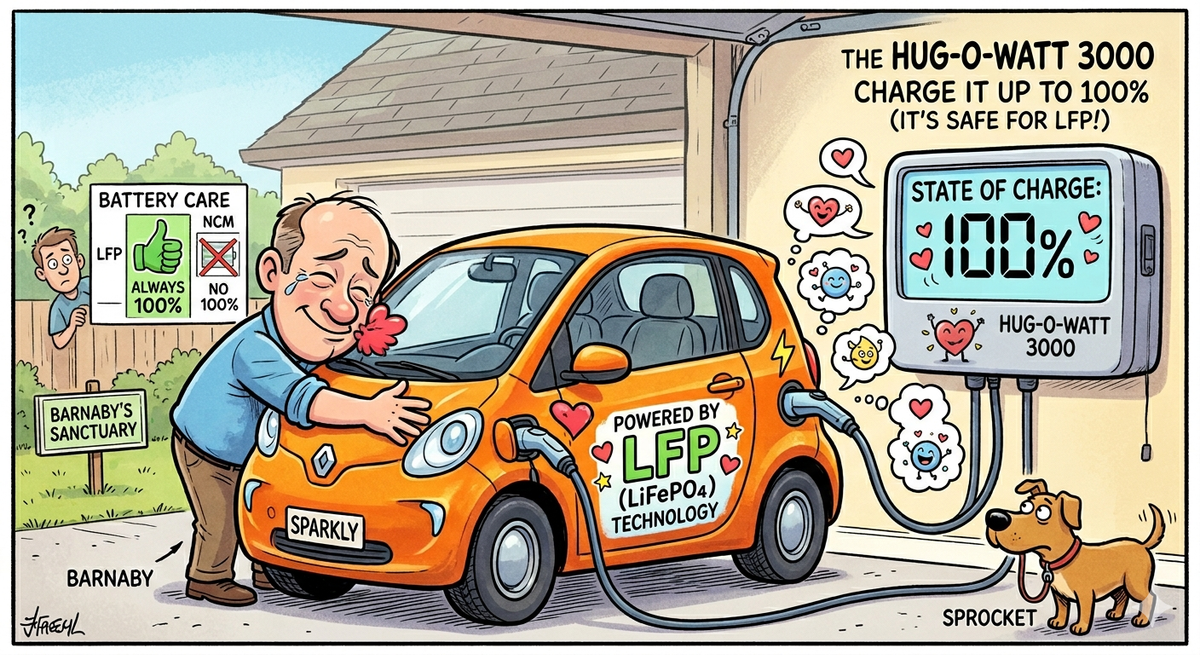
Avoid charging your vehicle all the way up to 100%? Especially at a fast charger? That's what we all think is standard practice to live a long and happy life with your EV right? Well not entirely. I fully realize what I will write in the next few lines will make some people quite nervous, owning a car should not be this difficult. But hey, we aim to inform.
How you have to treat your battery depends in part on its chemistry. While most guidelines hold true in general, owners of a vehicle with an LFP battery, like the Mercedes CLA 200, should adapt their behavior slightly. While this battery type is known to be a lot robuster than its high powered NMC cousin, it does come with its own drawbacks. The most irritating one has to be its very flat discharge curve in the usage area that the guidelines instruct you to stay in, between 20 and 90% state of charge (SOC). Given the difficulty to detect voltage changes the battery management system (BMS) has to guess where your battery is in terms of charge based on the vehicle's use. After a certain time spent in the operating zone between 20% and 80%, all the small mistakes in these guesses can add up to some serious deviations. Luckily the voltage of an LFP battery rises and falls much more aggressively at the extremes of the SOC. The BMS is then able to establish an anchor point for its next round of guessing. The best thing for an owner to do is to charge the battery up to 100% from time to time, most manufacturers advise once a week. To get a real hard recalibration done you can also follow the protocols that are going around on the internet for your specific vehicle like the one for the CLA 200 on this link (in German).
Grtz
Pieter
PS: As always, if you like what you are reading above, don't be shy and share. Signing up can easily be done on the link below.