Truck Update Q2 2026
Hi dear readers,
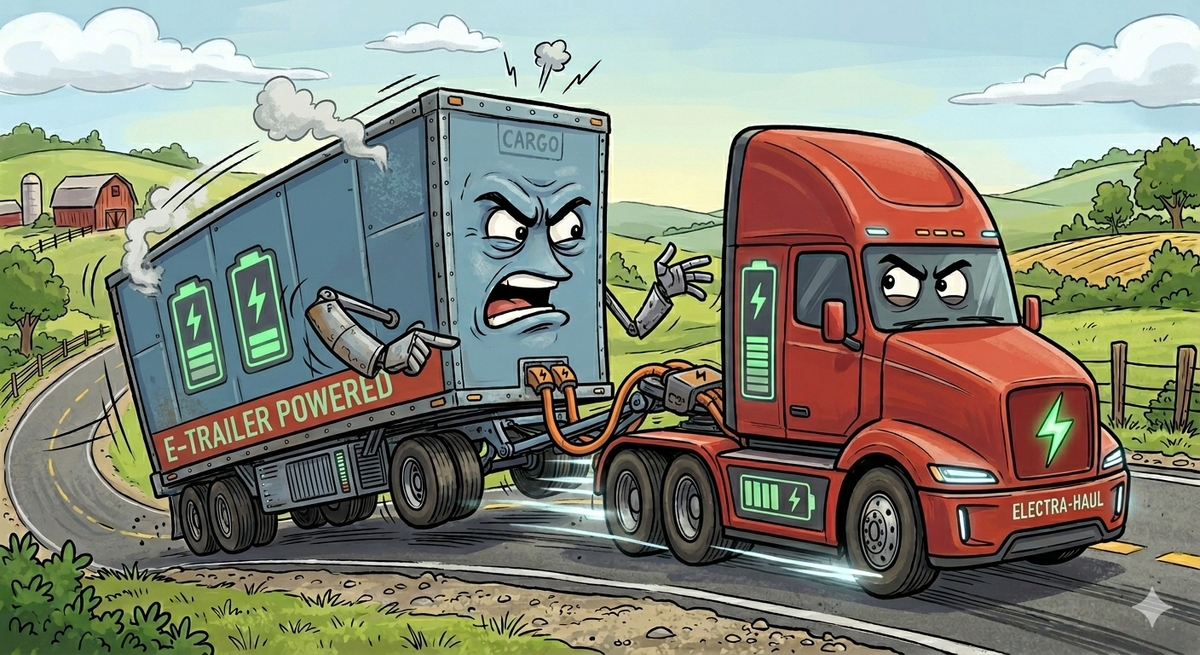
Who's Pushing who?
When you think of a typical tractor-trailer combination driving down some highway, what takes up the most mental space in your mind? What gets the most attention? Most people will answer the tractor. This is logical, it houses the driver and provides the enormous power to get all our stuff to the right location. The German company Trailer Dynamics changes that, well, dynamic. They are developing trailers with their very own electrified drive-train. A complete setup with battery and electric motors that support the tractor. The batteries can reach up to 550 kwh of energy content and charge at a DC charging station with up to 350 kw of DC power.
Why this solution? The truck market is still very much dominated by diesel tractors. Using an electrified trailer would basically provide logistics companies with a solution similar to plug-in hybrids in the car world. A kind of half step that allows them to save up to 50% on diesel consumption on the heaviest routes, while not having to go through all of the changes that are needed for fully electrifying.
To answer the question in the title, the trailer is legally prohibited from pushing the tractor. The most difficult technical part is exactly centered around this challenge. The trailer can provide enough support to move on its own, but never more than that. Intricate algorithms and sensors in the coupling have to assure that the calibration is exactly right. Not enough and you lose efficiency, too much and you are breaking the law.
For those who are familiar with the transport business the most important question is probably how much payload is lost due to the extra kit on board, especially the heavy batteries. That is indeed quite substantial, with an extra weight of 2.5 to 5.5 tonnes. The company is urging the European Commission to provide exemptions for electrified vehicles to compensate for this loss of payload.
Alone you go Fast, Together you go Far
One of the factors holding back the business case of electrified transport is the price of charging at public fast chargers. Subscriptions are easing that problem but there is still a substantial gap with the cost of electricity at a private depot or factory. There are now several initiatives underway to help solve this issue. They all start from the idea that sharing private charging infrastructure can be beneficial for everyone. The operators of electric trucks can charge their rigs at or near the destinations of the cargo and the owners of the depots, shops and factories can amortize their investment over many more charging sessions and kilowatt hours. Examples of this business model are the "Charge with Friends" platform from Austrian startup KW-Solutions and "Dragonize" the somewhat ominously named digital platform developed by German logistics provider TST Logistik.
You could argue that simply making your charging infrastructure public and allowing an electric mobility service provider to manage the payments would allow for the use of private charging infrastructure by others. The challenge is that the logistics sector has parameters that are different to what platforms originated in a car oriented world are focused on. Reservations, limited operating hours, specific hazardous materials rules on the property, size restrictions, etc....mean there is room for innovation.
Hoever, the new ventures better be quick as the old players in the ecosystem are not about to let their lunch be taken by others. DKV Mobility, a huge actor in the area of fuel related billing and services, has announced a specific charge card tailored for electric trucks. It focuses on some of the specifities mentioned above, and it has the distinct advantage of providing one integrated solution for the many hybrid fleets that are running a mix of fuel types in their fleet.
Toyota Swipes Right on Another German
Both Toyota and Daimler Truck are known to be stubborn supporters of hydrogen as an energy carrier for the future. While the first has been cooperating for a long time with BMW, the German truck company has a joint-venture with that other truck mastodont Volvo. As a sign of just how eager companies are to optimize their investments, Toyota is now joining that JV, Cellcentric, as an equal shareholder.
The move makes sense at this point in time. Building out the hydrogen solution as a second track towards a carbon free future is dangerous and expensive business. Given Toyota's history with fuel cells they are a massive addition in expertise and financial firepower. It also serves as a vote of confidence towards the entire supply chain that three corporate giants are pulling in the same direction to make this technology work. This is crucial as the buildout of refueling infrastructure and production of green hydrogen is falling behind that of high powered charging every month. At the time of the startup of Cellcentric hydrogen refueling stations outnumbered HPC ones 4 to 1. Less than five years later the situation is almost inverted with truck charging "charging" ahead and growing 20-fold.
Grtz
Pieter
PS: As always, if you like what you are reading above, don't be shy and share. Signing up can easily be done on the link below.