State of Robotics: Q3 2026
Hello dear readers,
DoorDash with a Bang, Delivery Robot Crashes Swat Intervention
As robots proliferate into our daily lives, the moments when they show their limits very often involve unpredictable situations like police interventions. Just like the Waymo car that drove through a stand-off recently, a DoorDash Dot delivery robot was caught in the middle of a SWAT intervention in Arizona. The delivery robot froze in place, unwilling to leave the scene, until the company sent out a technician to pick it up.
Even with the massive amounts of data that these machines are being trained on, there is very little that can prepare them for situations like these. The fact that it recognized the circumstances as out of the ordinary and freeze in place should probably be seen as quite a big step already. Moving away and listening to commands of the SWAT agents would require them to have the capacity to recognize these officers as having the power to boss them around and not being some pranksters. Can you imagine how much fun the neighborhood kids would have with Dot when they realized all you need to get them to turn around is a € 3 set of police accessories picked up in a toy store.
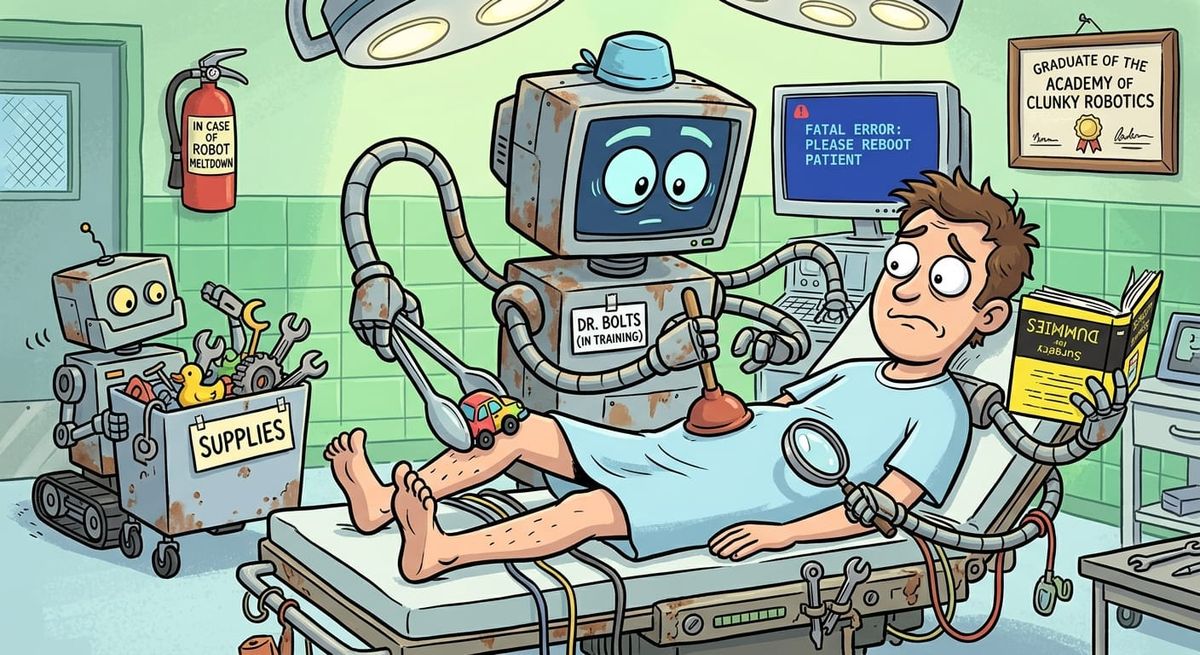
Dr Droid Makes First Cut
A humanoid robot, aptly named Surgie, made a big stride forward recently. In a standard surgical setting the machine made its first incision and performed a full operation on an anesthetized pig. Important to mention here that it was not in a fully autonomous mode, but controlled by expert human surgeons.
While "robots" have been used in surgery for many years, it requires a super specialized setting for the robotic arms to fully function. Humanoid robots have the distinct advantage that they resemble, well, humans. Their "bodies" are easier to incorporate into a standard operating room, sharing the space with the actual real-deal medical staff. They should also be transportable into remote settings where staff shortages or conditions make it challenging to provide expert presence.
Of course there is a very long way to go before these machines are let anywhere near a real human patient, let alone operate on their own without human control. Although the test went perfectly well from a results perspective, there were some interruptions to reposition and challenges with cooling. For now Surgie is better off helping its human colleagues than actually wielding the scalpel.
Grtz
Pieter
PS: As always, if you like what you are reading above, don't be shy and share. Signing up can easily be done on the link below.