State of Autonomy: Q1 2026
Hello dear Wanderers,
Stop!! Where is the Ecosystem Going?
I thought it would be nice to start this newsletter with a quick overview of where autonomous driving is currently at and who is taking position to get into the action on the fully autonomous ride hailing business. Not the "my car in my driveway is autonomous" but the "I will take this instead of a taxi or a bus".
THE autonomous driving companies like Waymo, Tesla, Zoox, Baidu, Pony ai, etc... The companies that build and operate the vehicles and technology stack that make the product work. In the West, the biggest is Waymo which is putting in a real sprint in 2026 and has a fleet of 2.500 cars running around and over 1.000.000 (yes, one million) MAUs. Don't know what a MAU is, don't worry, I had to look it up as well. It stands for Monthly Active Users. Not the tourists who take a spin around San Francisco, but repeat users for whom taking a fully autonomous taxi is as normal, or even more normal, than a human piloted one. Biggest competitor of Waymo is probably Baidu who has racked up 3.4 million trips in the fourth quarter of 2025 with its Apollo Go product in China.
The integrators like Uber. Having abandoned the development of the technology for themselves years ago, these companies realize evolution will massively influence their business model in the future. While currently the traditional ride hailing business still dwarfs the fully autonomous one, Uber has 42 million MAUs, there will come a time when costs come down enough for drivers to lose out to technology. Uber is pulling out all stops to make sure it is well positioned on the entire value chain to be the reference in autonomous ride hailing when that happens. They integrated all the necessary services into a product called Uber Autonomous Solutions. This big umbrella covers everything from fleet financing to high definition mapping and fleet operations to vehicle insurance. Oh, and they are throwing $100 million at the development of dedicated fast charging stations for their autonomous fleets. While it will take a while before the computers can match human drivers on cost, estimates are that robotaxis take €4-5 per kilometer to operate where a traditional driver based system sits around €1-1,5, Uber is sparing no expense to be at the forefront.
And then there are the hardware providers, who will gain if the autonomous revolution breaks through. Jaguar, Chrysler, Hyundai, Lucid and many others have contracts to deliver the base vehicle. But pretty soon you can be quite certain that the volumes will be interesting enough to develop bespoke versions. Zeekr seems to have advanced the furthest in this, developing the Zeekr RT specifically for autonomous use. Sliding doors make getting in and out in tight spaces or next to sidewalks and biking lanes less dangerous. The sensors have been integrated a bit better than in converted cars and it even runs a self cleaning ritual of all those sensors every time it is plugged in at a charging station.
We Ain't There yet!
For all the progress that has been made, it is only fair of me to highlight the obvious as well, autonomous technology will take years to make a real dent in vehicle sales. Bloomberg New Energy tallied up the numbers nicely in their annual passenger vehicle outlook. They are predicting "peak car" in 2037, exactly 20 years after peak combustion in 2017. While this peak is mostly shaped by demographics and urbanisation, their calculations show that increasing autonomy will start having a serious impact by 2040. While the fleet share of fully autonomous shared vehicles is predicted to be only 1.6% of the iron on the road, they are foreseen to cover a full 7% of the distance traveled.
Hi World, Meet Waymo
As the services of autonomous ride hailing firms like Waymo continue their growth in locations and numbers, they go from something exotic to part of everyday life. Here are some recent stories that show just how mature the business is becoming, with all the good, bad and quirky that it entails.
Autonomous vehicles have largely skipped the combustion era. Whisking people around in cities that are willing to give you a license to operate is probably impossible if you use stinking diesels. Going electric creates its own challenges though. Neighbors of some Californian charging stations are discovering a harsh reality of autonomous fleets. They use the calm nighttime hours to get charged up and that seems to cause quite a ruckus. All those AVs with their beeping sounds when backing up, blinking lights, whizzing chargers, etc...are keeping folks up at night. We will see this issue repeating itself all over the world. The business case of operating autonomous vehicles dictates you perform your operations as close to your customers as possible. tT the owners of some inner city industrial real estate, don't sell quite yet! To those who live close by, install some super insulating windows.
While your average cab driver can get you home unperturbed during a blackout, maybe even faster than normal without those pesky red lights, an autonomous vehicle becomes a sitting duck. During a recent power failure in San Francisco Waymo was forced to suspend its services as many of its vehicles went into safety mode in the middle of the street.
The world of Waymo isn't all doom and gloom though. Also in San Francisco a woman gave birth while in the back of an AV on her way to the hospital. The technology even alerted the remote rider support team as it registered that the activity in the back did not fit its normal parameters. Mom and baby apparently made it safely to the hospital. Now that's what I call a strong story to start your life with!
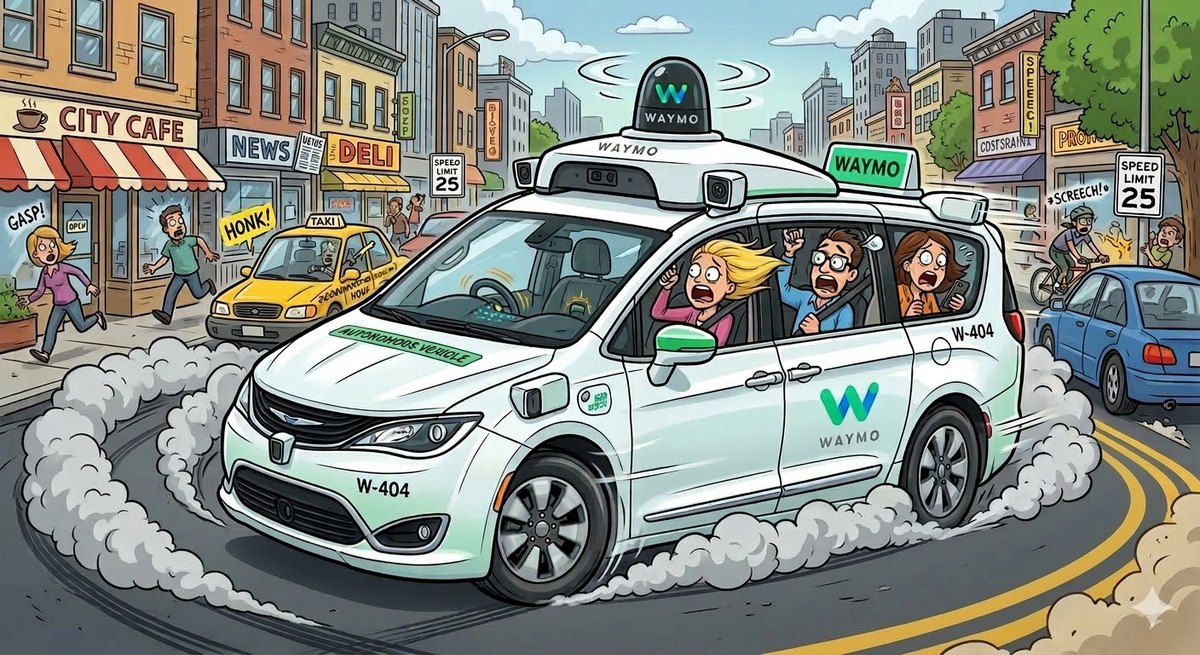
One of the gripes of intensive users of Waymo is the extremely careful and slow way it navigates its routes. First time users probably find comfort in the fact that the computers are checking extra carefully where they are going, but in the end the reason for getting into one is to get somewhere, preferably FAST. Well, you can't fault the company for not listening to their customers. Users have apparently been noticing that the driving style of their AV has been dialed up to 10. That even includes some moves that are not quite completely within the letter of the law, like rolling through stop signs or making illegal u-turns.
The Oldies are Back
As the technology progresses, not all car manufacturers are content with just delivering the hardware for the Waymo's of this world. They want to continue to be relevant in the world of tomorrow as well. Tesla is the obvious, although quite invisible for all the bluster, example. But others are not sitting still either.
Hyundai's Motional division for example announced that they will be launching a partnership with one of the major ride hailing firms in Las Vegas ver soon. The Koreans are determined not to let the bad experience of GM with Cruise or Ford with Argo AI determine its strategy.
Talking about Ford, they are not completely out of the race yet and have announced that they will have level 3 technology in their trucks. I don't know just how comfortable I will feel with one of those F-150s behind me when the driver is scrolling on Tik-Tok, but it should be possible in only two short years!
While Ford is poised to take a step forward, leader Mercedes-Benz seems to be taking one in the opposite direction. Although they were one of the few manufacturers that had level 3 cars on the road, they seemingly decided that all the system redundancy needed to make it completely safe and acceptable is just too expensive. The newest benzes will therefore come with a system that is only level 2++. The extra plusses are there to indicate that it is technically just as capable as level 3, and this has so far been confirmed by people who have gotten to test it. BUT, it's not level 3, so legally you are still liable for everything the car does. No reading your emails or finishing a team's call without keeping your eyes on the road, exactly what I and millions of others are pining for. The company has indicated it is in no way stepping back from its ambition to one day offer fully autonomous vehicles to its customers, but does admit that the so-called "long tail" of development to get from 99% to the full 100% of even the rarest driving scenarios is long and hard work.
China Pushes Back...HARD!
In China all the noise on social media around some high profile accidents with so-called autonomous functions are beginning to have their effects. Both the judiciary and the government are taking action.
The Chinese Supreme court for its part has decided to dissipate any confusion on the use of driver aids. Except in the very rare cases where all the necessary official approvals have been given to let vehicles operate at a level 3 or higher of autonomy, the driver stays the final responsible party. Drivers should be very much aware that the agressive marketing for "self driving" cars, here's looking at you Tesla, is just that: MARKETING. Just like you shouldn't believe that you will turn into one of the pretty people in commercials just by wearing the right closes or spritzing the right fragrance, you should also not take a nap in your so marketed autonomous car.
The regulator is showing a similar push in setting the bar of L3 capable cars much closer to level 4. What is the difference again? Well, level 3 autonomy effectively means that under the right circumstances the driver can be legally exonerated from driving the vehicle and hand over control to the car. He must however be able to retake control when so instructed by the technology. And that's where the new rules have become much stricter. In the future the level 3 autonomous car must have the capability to guide the vehicle to a parking location that doesn't obstruct traffic when the driver remains unresponsive. Quite a big jump in requirements and actually pushing the base L3 bar much closer to L4 where vehicles are indeed supposed to be capable of driving themselves under most conditions. You could even argue that the regulator is pushing the bar towards level 5 in some cases. Imagine you are driving on a sunny mountain highway without a care in the world and go for a very deep nap. When you don't wake up despite urging from your car during a sudden fierce summer downpour or a wintery snow storm, the car would in some cases have to be able to get off the highway onto small local roads to find parking in an area that has no high definition mapping. That is textbook level 5! It will certainly make future autonomous vehicles much safer but also pushes the actual implementation on volume production much further out.
I hope you enjoyed the read!
Grtz
Pieter
PS: As always, if you like what you are reading above, don't be shy and share. Signing up can easily be done on the link below.