Charging Update Q1 2026
Hello my dear Wonderers,
Ever Faster
There has been tremendous progress made on the charging speed front. The last year has seen the bar of what a really fast charging car us move ever higher. Where Hyundai, Kia, Porsche or Audi used to be pretty impressive with 250 kw+ numbers, you tend to think "nah" when reading about a new car that crosses the 200 kw bar. 400 kw will pretty soon be the new normal, and the progress is not about to stop there. Both BYD and Xpeng have presented vehicles that will go well beyond this threshold and that other behemoth Geely could not stay behind. Their Zeekr brand has announced that the, not old by any means, 7X will get an upgrade to a 900 volt platform instead of the 800 v one. At least for the top versions 600 kw of peak charging power will be within reach.
Charging up in the Air
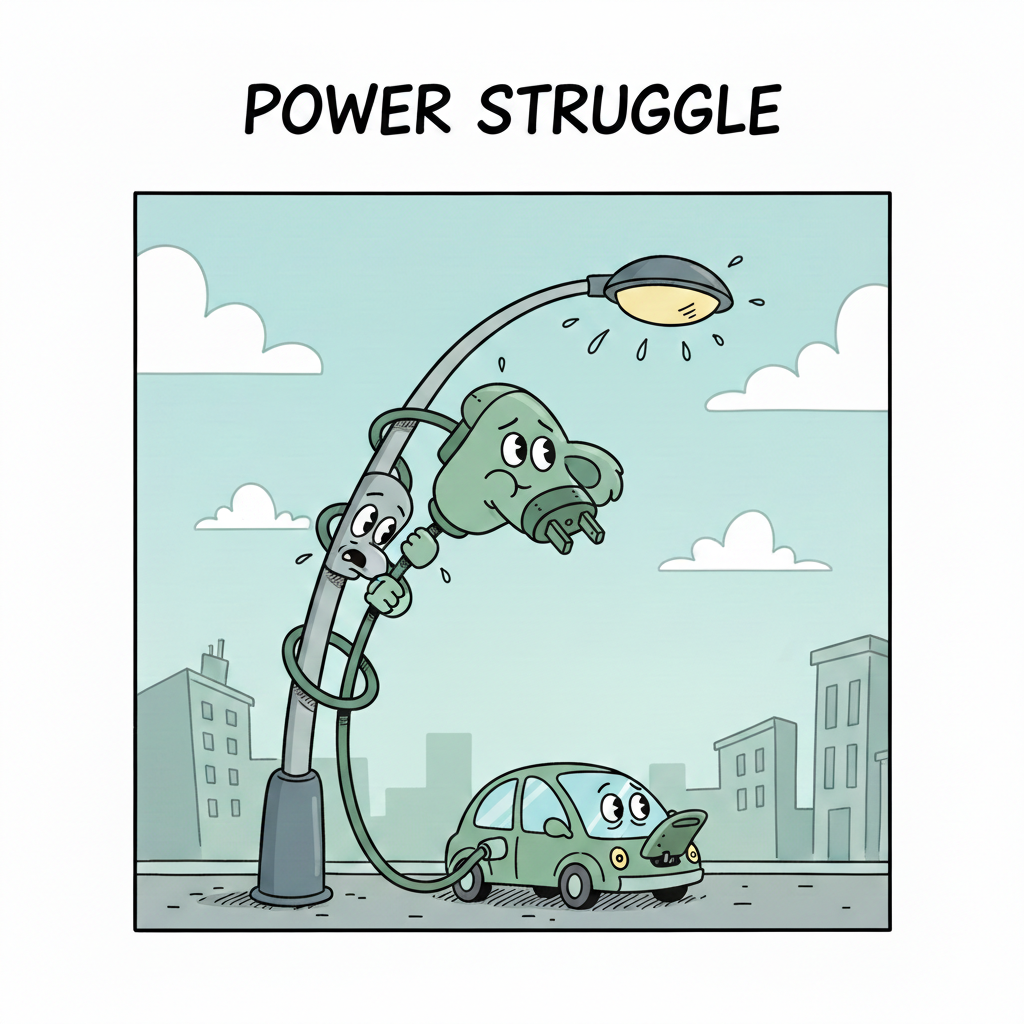
Getting cars charged on busy city streets is no easy feat. Cars, pedestrians, parking, bicycle lanes,.... public space comes at a real premium. Voltpost might have found a perfect solution using the ubiquitous lamppost. Their chargers wrap around the pole and can retract the charging cable inside when not in use. The only "downside" being that available power will only allow for slower AC charging. Given the time your car will need to spend charging this is the perfect solution for locations where it tends to stay for a while, think offices or near homes. Not for your typical busy shopping street but perfect for residential neighborhoods!
Track Those Thieves
InstaVolt is tired of the increasing wave of cable theft hitting charging infrastructure. Very sought after as they contain a large amount of copper charging cables are usually the weak link for a charging station operator. Cables have to be easy enough to manipulate and long enough to reach charge ports to make the user experience acceptable. Exactly the traits needed for thieves to make off with them in an efficient and timely manner. To combat this type of crime the operator has started installing GPS trackers that warn the control center when they leave their geo-fenced area, providing police and security services exact locations to lasso in the cable crooks.
Keeping the net Stable
As a leading country on the road to electrification, the Netherlands is also suffering heavily from the pressures on its electricity grid. Cars tend to be used during the day after which they are hooked up to a charger exactly when the net is trying to survive the evening peak. Luckily the country has something working in its favor. Zoning and construction habits have created a situation in which the densest part of the country has a relatively limited number of private parking spots on driveways or garages. This means EV drivers rely on a big number of on-street public chargers. It is these chargers that are now being used successfully, by the thousands, to apply the rules of "grid conscious" charging. When that grid approaches its maximum limit the chargers are dialed back or even pauze their sessions completely. Starting back up when the congestion eases. In a future where vehicle-to-grid technology is more widespread the infrastructure and the vehicles hooked up to it will even be able to increase the total capacity.
V2G no Longer Taxed Twice
A few words in a legal text can make a world of difference to a nascent technology. In Germany that has now taken place for vehicle to grid (V2G) charging. In the future you will no longer have to pay grid fees or electricity tax on energy taken off the grid, stored in your car and then fed back into that grid at a more opportune moment. Thus taking away another hurdle in the adoption of widespread vehicle to grid solutions. Solutions that could, according to some studies, bring in € 500 per year for the average EV driver.
Link: https://www.electrive.com/2025/11/14/germany-clears-the-way-for-bidirectional-charging/
Small Step for Tesla, big Help for Users
For all the practical use of Google maps it is still surprisingly useless for EV drivers. I find myself juggling multiple nav systems to make use of their strengths. Waze for the excellent alternative routes, the native navigation to make sure the battery is preconditioned on time, Flitsmeister for taxation optimization😉,... And yes, from time to time Google Maps as there is no better alternative to find a point of interest (POI) along your route. But the dream is still alive that at some point in the future one app will cover all needs and then having occupation rates will be immensely important to put together a decent charging plan. It's good to see that one of the biggest, both OEM and charging station operator, Tesla is now sharing that info with Google.
BMW Charging Takes big Step....and Then Stops
BMW seems to understand that corporate fleets are hugely important for their numbers. It's great to see that they have therefore created a fleet charging card in which all charging sessions with company cars can be managed in a central account. Even more importantly the solution can be used for non BMW (or Mini) vehicles. Such a pity then that the maximum threshold is 50 vehicles, making the solution only accessible to smaller companies.
Enjoy the read!
Grtz
Pieter
PS: If you think this newsletter could interest someone you know, please forward this email. They can sign up for free on this link.